
Planting Season Playbook: What Smart Growers Are Doing Differently With Weed Control This Spring
By Christie & Co Communications for LASCO Lightning Weeder
By the time this issue hits your desk, spring fieldwork will be in full swing across the Central Valley. Beds are being shaped, transplants are going in, and in many fields, weeds are already making their move. None of that is new. What is changing is how growers are choosing to respond.
For decades, the standard play was straightforward: spray early, spray often, and rely on chemistry to keep fields clean through the season. That approach still works in plenty of situations. But across the San Joaquin Valley and beyond, more growers are adding non-chemical tools alongside their spray programs — not replacing them, but layering in additional methods to deal with problems that chemistry alone is struggling to solve.
The reason is simple: herbicide resistance is no longer a distant headline. UC Davis and Fresno State researchers have confirmed ALS-inhibitor resistance in common chickweed populations in the southern San Joaquin Valley. Glyphosate-resistant weeds — including hairy fleabane, horseweed, and Italian ryegrass — are well documented across orchard and vineyard regions throughout the state. Palmer amaranth, one of the most aggressive resistant weeds in the country, is showing up in California cotton. When a grower’s go-to herbicides stop working on a weed that used to be easy to control, the farmer needs a new solution.
Math is what’s driving the shift. When a spray program fails or underperforms, the follow-up options aren’t cheap. More passes, more products, more fuel, more labor — and tighter windows to get it all done before crop development makes it too late. Growers who are rethinking their approach aren’t doing it because they read a magazine article about sustainability. They’re doing it because the numbers on their cost sheets told them something had to change.
Adding Tools, Not Replacing Them
The growers getting out ahead of this aren’t abandoning their spray rigs. They’re building what the university extension folks call integrated weed management programs — which, in plain terms, means using more than one method to hit weeds from different angles. Cultivation, cover cropping, targeted mechanical removal, and increasingly, electrical weed control are all showing up as layers in the program.
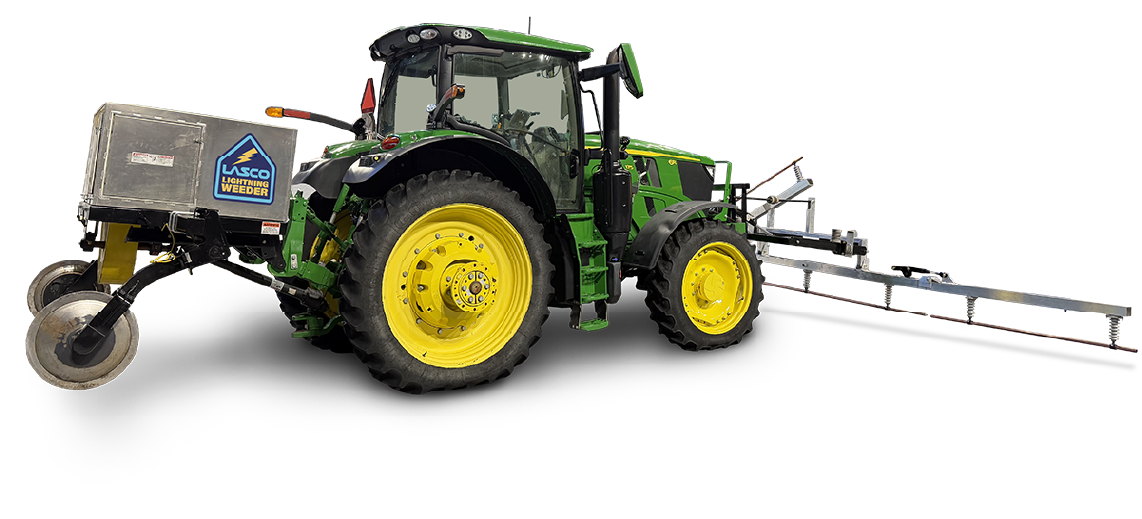
Electrical weed control has been around longer than most people realize. LASCO has been developing the technology since 1979 — 47 years of building, testing, and refining in real field conditions. Their Lightning Weeder uses an Electric Discharge System that delivers precise electrical pulses directly to weeds, disrupting plant tissue from root to shoot. The crop and soil stay intact. No chemical residue. No soil disturbance. The system runs at 2–6 MPH, the height is adjustable for different crops, and it includes a safety interlock system for operator protection.
Kevin Olson, who founded LASCO alongside his wife Linda, has spent his career farming and building equipment to solve the problems he saw firsthand in the field. As he puts it: “The Spring season sets the trajectory for the entire year, and farmers don’t have the luxury of waiting when weeds get ahead. When early weed pressure goes unmanaged, it drives up costs, erodes yield potential, and ultimately affects the price and availability of food.”
Timing Is the Whole Game
Every grower in the Valley knows that the first few weeks of the season set the tone for everything that follows. Weeds that get established early compete aggressively with young crops for moisture, nutrients, and sunlight — right when the crop is most vulnerable. Miss that window and you’re chasing the problem for the rest of the year.
That urgency is exactly where a tool like the Lightning Weeder fits. It gives growers a way to make passes on emerging weeds without adding chemical inputs or disrupting the soil biology they’ve been working to build. Three passes per season is typical for optimal control — hitting weeds when they’re young and scattered rather than waiting until they’re mature and dense. As a general rule, the time to make a pass is when weeds stand about four to six inches above the crop canopy.
For organic operations, specialty crops, or any field where chemical options are limited, that kind of flexibility matters. But conventional growers are finding value too. Adding a non-chemical pass between spray applications can reduce selection pressure for resistant biotypes while still keeping fields clean. It’s not an either-or proposition. It’s another tool in the shed.
What to Think About Right Now
If you’re finalizing your spring weed management plan, here are the practical questions worth asking: Which fields had herbicide escapes last year? Where is resistance showing up in your area? What’s your backup plan if your primary spray program underperforms? And are there spots in your rotation where a non-chemical pass could take pressure off the chemistry you’re relying on?
The growers who are adapting fastest aren’t the ones making dramatic overhauls. They’re the ones adding one or two tools to a program that’s already mostly working, and tightening up the weak spots before they become expensive problems. That’s smart farming. Always has been.
About LASCO
LASCO develops a chemical-free weed control system that gives farmers reliable tools to reduce complexity, restore soil vitality, and diminish chemical dependence. The LASCO Lightning Weeder uses an electric discharge system (EDS) to facilitate weed control while also ensuring zero damage to crops.
The Lightning Weeder received the Blue Ribbon Award at the 2026 International Sugarbeet & Dry Bean Expo.
For more information, visit www.lightningweeder.com