
Honey Bees Can Detect Viruses in Food
By Jessica Ryan, ARS Office of Communications
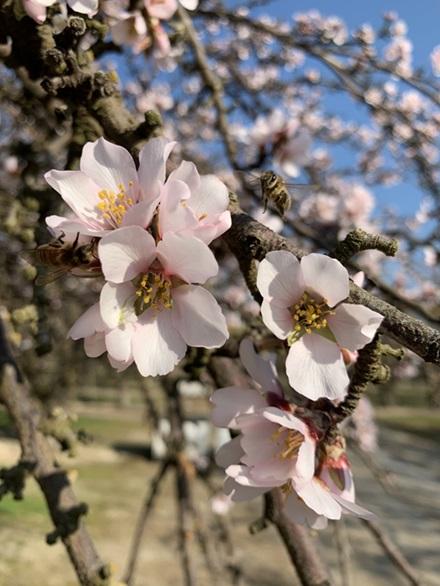
Honey bees (Apis mellifera) forage for pollen and nectar on almond flowers. (Photo by Michael Simone-Finstrom, ARS)
Honey bees encounter viruses in their environments, especially when they forage on flowers and other food sources. Being able to detect viruses is important for reducing infection and the spread of disease. Many insects, including honey bees, can detect viruses indirectly with sick nestmates, but it has been unclear if honey bees can directly detect viruses in food sources.
To help beekeepers protect their colonies by reducing viral spread, ARS researchers from the Honey Bee Breeding, Genetics, and Physiology Research Unit in Baton Rouge, LA, studied if honey bees could sense viruses such as deformed wing virus, black queen cell virus, and chronic bee paralysis virus in contaminated food sources.
In an experimental study, the researchers found that when honey bees were presented with the choice between a spiked sugar solution with viruses and a plain sugar solution, the honey bees preferred the virus-spiked solution.
“These findings demonstrate that honey bees can directly detect the presence of viruses in contaminated food sources, which has important implications for pathogen transmission within pollinator communities and disease management strategies aimed at improving honey bee health,” said Michael Simone-Finstrom, ARS Research Molecular Biologist.
According to Simone-Finstrom and ARS Research Entomologist Elizabeth Walsh, both co-lead authors of the study, the results highlight the need to control viral infections and spread in bee colonies.
One major concern is viral spread from Varroa mites, parasitic pests that feed on honey bees. Currently, controlling Varroa mite populations is one of the most effective ways to protect honey bee colonies. Beekeepers can consider changing how they feed honey bees to limit outside insects from getting access to their food, according to Simone-Finstrom and Walsh.
“Open feeding scenarios where bees from different colonies and other insects, who may carry viruses, get food from the same source may not be in the honey bees’ best interest,” said Walsh. “Beekeepers can consider an alternative like an individual colony feeder where only honey bees from one colony have access to the food.”
It is unknown what mechanisms cause bees to gravitate towards the contaminated food sources. More research is underway to better understand honey bees’ foraging behaviors and how the viral presence affects their behaviors.
“The study’s findings will help us with providing data-driven decisions in honey bee management and ecological decisions,” said Walsh.