
Brewed Awakening: UC Explores Tea’s Potential as California’s Next Champion Crop
By Michael Hsu — Editorial Adaptation
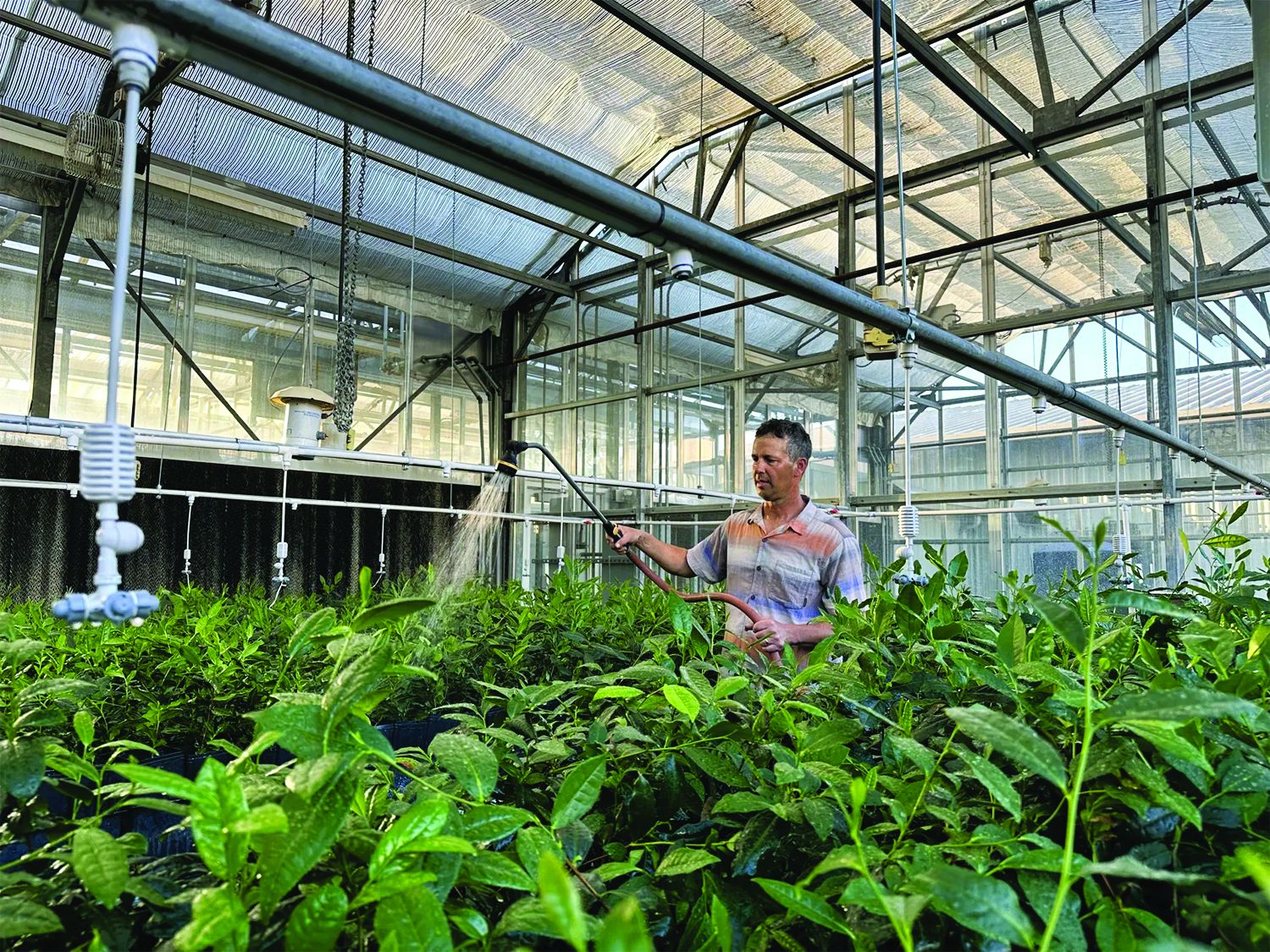
At Kearney REC, the 3,000 tea plants in the greenhouses and 1,000 tea plants in the field are testament to the suitability of tea growing in the Central Valley. Photo by Michael Hsu
UC ANR research suggests tea could offer high-value returns on smaller acreage.
After six decades of farming oranges, pistachios and grapes in Fresno County, grower Stan Ishii didn’t expect to see tea thriving in the Central Valley. But curiosity brought him—and nearly 100 others—to Tea Day at the UC Kearney Research and Extension Center in Parlier, where researchers shared new findings on the viability of Camellia sinensis in California’s arid climate.
“Tea could be one of the champion crops for the future of agriculture in California because it’s a high cash‑value crop and a climate‑resilient crop,” said Atef Swelam, director of Kearney REC and West Side REC. With the Sustainable Groundwater Management Act expected to retire up to 1 million acres of farmland by 2040, Swelam sees tea as a profitable alternative. Some studies suggest tea can generate 5–15 times more revenue per acre than traditional crops—and even more compared to almonds.
A Climate Match for Tea?
UC Davis researcher Jacquelyn Gervay‑Hague traced the region’s tea history back to a 1960s Lipton‑funded project that identified cultivars capable of thriving in the Central Valley. Her recent work shows tea performs well under drip irrigation, and California’s dry climate actually benefits harvest quality.
“In other parts of the world, too much rain can really destroy the tea plants,” she said. Dry conditions reduce disease pressure and allow growers to harvest leaves at ideal moisture levels.
At Redwood Tea Estate near Stockton, owner Patrick Sunbury sees similar advantages. “We don’t have to use fungicides because of the dry climate,” he said, noting that caffeine also acts as a natural pest deterrent. Intense sunlight and wide day‑night temperature swings add “stress” that enhances aroma and flavor—similar to prized high‑altitude teas in Asia.
A Case Study in Small‑Acre Profitability
Sunbury, a landscape architect turned tea farmer, began with a half‑acre plot in 2020. With no established U.S. infrastructure or extension guidance, he relied on trial and error to identify cultivars suited to his terroir. By 2024, his plants reached harvest maturity, allowing him to produce white, green, oolong and black teas from the same species.
He now sells primarily through a tea club, offering quarterly shipments of farm‑grown looseleaf teas. Festivals and direct sales supplement income, and he plans to expand to three additional acres in Lodi.
“Tea can be a relatively finicky plant,” he said. “Start small, be patient, and expand as you learn.”
Growing Demand Through Culture and Generational Shifts
Speakers at Tea Day emphasized that U.S. tea culture is still developing. While coffee sophistication has surged, most Americans still consume low‑grade bagged teas. Lecturer Alex Ng of National Chung Hsing University described tea as a cultural experience that brings people together—something the U.S. market has yet to fully embrace.
Younger consumers may drive change. Fresno City College student Eleni Deamant sees tea aligning with trends away from sugary drinks. “Matcha is already popular,” she said. “I hope white and oolong teas become part of the younger generation’s culture.”
Attendee Sue Ruiz noted that health‑based marketing helped propel crops like pomegranates and pistachios. “Why can’t we do that with tea?” she asked.
Labor, Mechanization and Water: Key Research Questions
Harvesting premium tea is labor‑intensive. A skilled worker may need one hour to pick a pound of fresh leaf—yielding just a quarter‑pound of finished tea. Gervay‑Hague sees this challenge as an opportunity to build modern infrastructure from scratch, incorporating mechanization and advanced processing.
Kearney REC is already testing a handheld tea harvester and launching studies on ag‑tech integration, irrigation efficiency and cultivar resilience. Water remains a top concern for growers like Ishii and community advocates like Ruiz, who see tea as a potential lifeline for small farmers—if water requirements prove manageable.
Sunbury hopes UC research will also focus on heat‑tolerant cultivars. “We had to do our own breeding program,” he said. “Insights from UC would be invaluable.”
A Growing Research Frontier
With 1,000 plants in the field and 3,000 in greenhouses, Kearney REC plans to expand by another 1.5 acres. Researchers will evaluate soil conditions, irrigation strategies, pest management and mechanization. UC Davis sensory scientist Jean‑Xavier Guinard is developing a tea flavor wheel, similar to those used in wine and coffee.
Consumer enthusiasm is already evident. Sunbury’s farm tours fill quickly, even without advertising. “People want to connect with a tea farmer,” he said. “Having a tea farm here gives them that opportunity.”